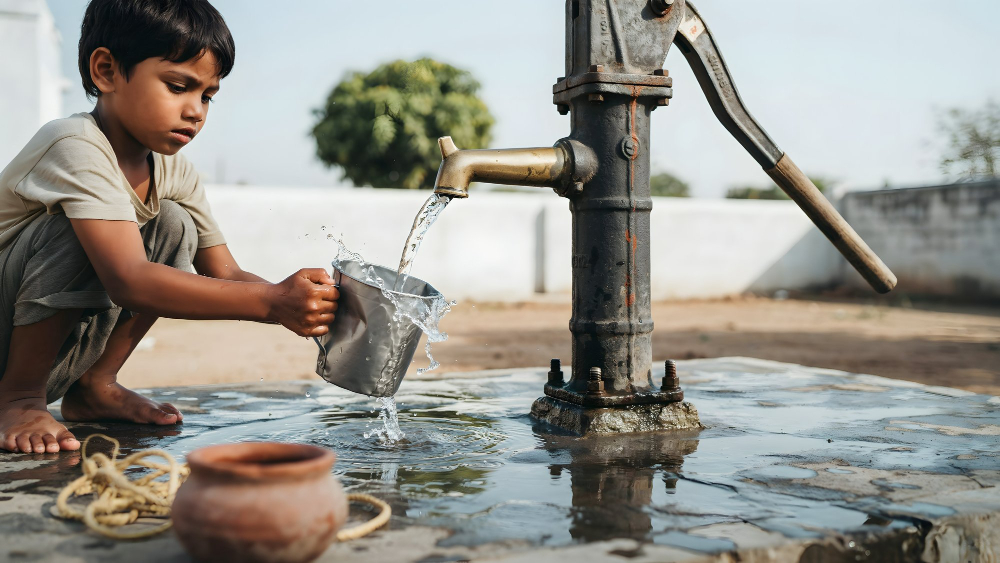
The Indian state of Karnataka saw two strikes in one week, called by different factions. They were protesting against the decision of a central tribunal, to release water to neighbouring state of Tamil Nadu. So, what is this all about? Have we actually started fighting seriously over water? In the 20th century, wars over oil shaped history, but the 21st century presents a different threat: conflicts over water. As climate change exacerbates water scarcity and regional instability increases, the question arises: could this lead us into World War III?
Water, the Elixir of Life
Water is the foundation of sustainable development, essential for ecosystems, socio-economic growth, energy, food production, and human survival. Pope Francis once pondered whether the world was moving towards a “great world war for water” amidst the ongoing global crisis.
A Rising Alarm
While concerns over water scarcity have escalated over the past few decades, successive UN Secretary Generals have warned about water conflicts:
- Boutros Boutros-Ghali in 1985 predicted that the next Middle East war would revolve around water, not politics.
- Kofi Annan in 2001 foresaw fierce competition for fresh water as a source of future conflict.
- Ban Ki Moon in 2007 highlighted water scarcity’s severe consequences, including its potential to fuel wars.
The Escalating Crisis
Dire Predictions
The Water Wars Theory
Water’s Critical Role
Journalist Steven Solomon posits that many modern conflicts will center on water, surpassing oil as the world’s scarcest critical resource. Freshwater accounts for a mere 2.5% of Earth’s supply, most of which is locked in glaciers. With a doubling of global water use in the last century, countries are now divided into “water haves” and “water have-nots.” Rajendra Singh, known as the Waterman of India and a Magsaysay awardee, asserts that water mismanagement, encroachment, and pollution are wreaking havoc in India, with water scarcity potentially triggering World War III.
Historical Precedents
Water-related conflicts are not new to human history, with examples dating back to Mesopotamia, Assyria, China, and Egypt. In contemporary times, disputes persist in regions like Israel-Palestine, Mozambique-Zimbabwe, Bolivia-Chile, and Turkey-Syria-Iraq. As a result, the UN has identified nearly 300 areas where conflicts over water are likely.
Preventing Water Wars
Addressing water challenges involves two main categories: water infrastructure problems (capacity to harness and distribute water) and water resource problems (declining surface and subsurface sources). Effective policies must align with environmental, forestry, and industry strategies to restore and rejuvenate water levels. In urban areas, where 55% of the world’s population resides (projected to reach 68% by 2050), integrated approaches are crucial. Rajendra Singh’s “water is climate and climate is water” campaign advocates the six R’s: respect, reduce, retreat, recycle, recharge, and rejuvenate.
Global Responsibility
Building water resilience and mitigating conflict risks require worldwide collaboration. Water-sharing agreements, like the Indus Waters Treaty, have successfully reduced disputes. Reducing water usage, optimizing infrastructure, curbing agricultural overuse, desalination, and wastewater treatment are among the recommended steps.
Increasing global desalination and wastewater treatment capacity could reduce severe water scarcity from 40% to 14% of the population. As the world’s population continues to grow, addressing the water crisis is imperative for the planet’s future. The time for action is now. Our planet’s fate depends on it. Doulton is committed to making the world more sustainable with products that not only have zero water wastage and zero use of electricity, but also can be used as compost once their life is over.
Contribute to a better world by investing in products that not save your earnings, but also are highly susainable. Doutlon water filters offer highly sustainable and eco-friendly products.
Speak to a water expert find the best water filter suitable for you
If your water source is borewell/tanker etc with TDS above 500 ppm, we do not recommend Doulton Water Filters.
"*" indicates required fields
You might also want to read